

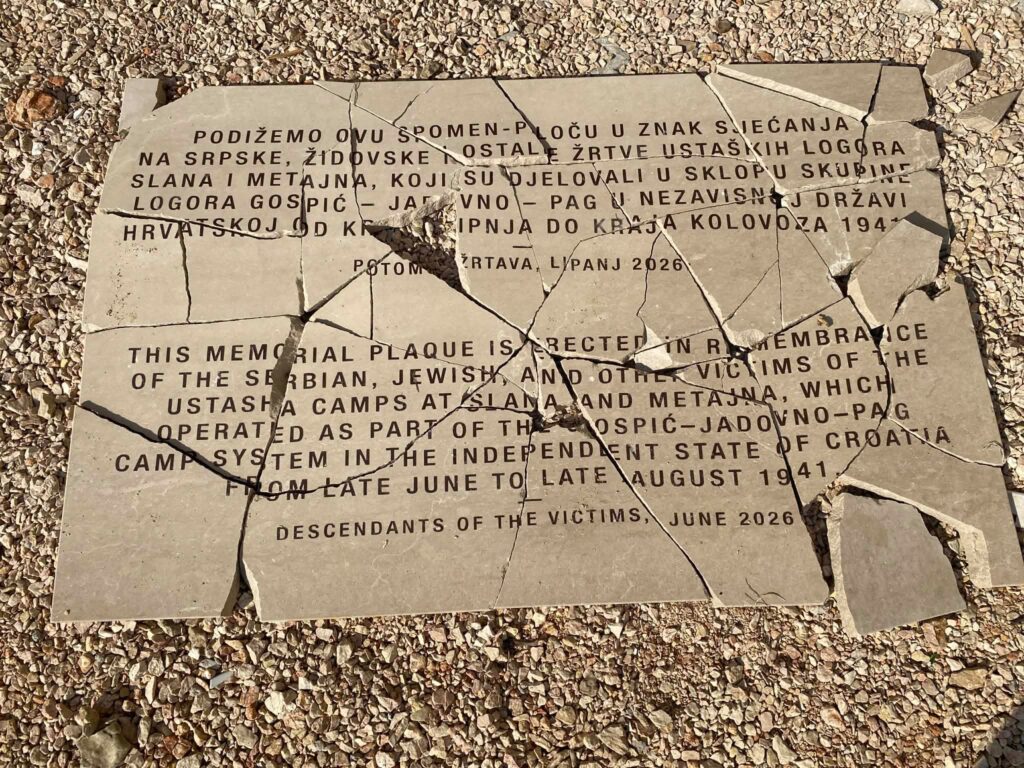
The memorial plaque dedicated to the victims of the Ustasha camps in Slana and Metajna, which were an integral part of the Gospić-Jadovno-Pag concentration camp system, and which was first installed in 1975, has been destroyed for the fourth time since 1991 in Slana Bay on the island of Pag.
The Serb National Council (SNV) and the Coordination of Jewish Municipalities of the Republic of Croatia installed a replacement memorial plaque in 2010 and again in 2013, both of which were subsequently destroyed.
On 24 June this year, the memorial plaque was restored and installed for the fourth time, with new wording, in cooperation with the Mayor of Novalja, Ivan Dabo.
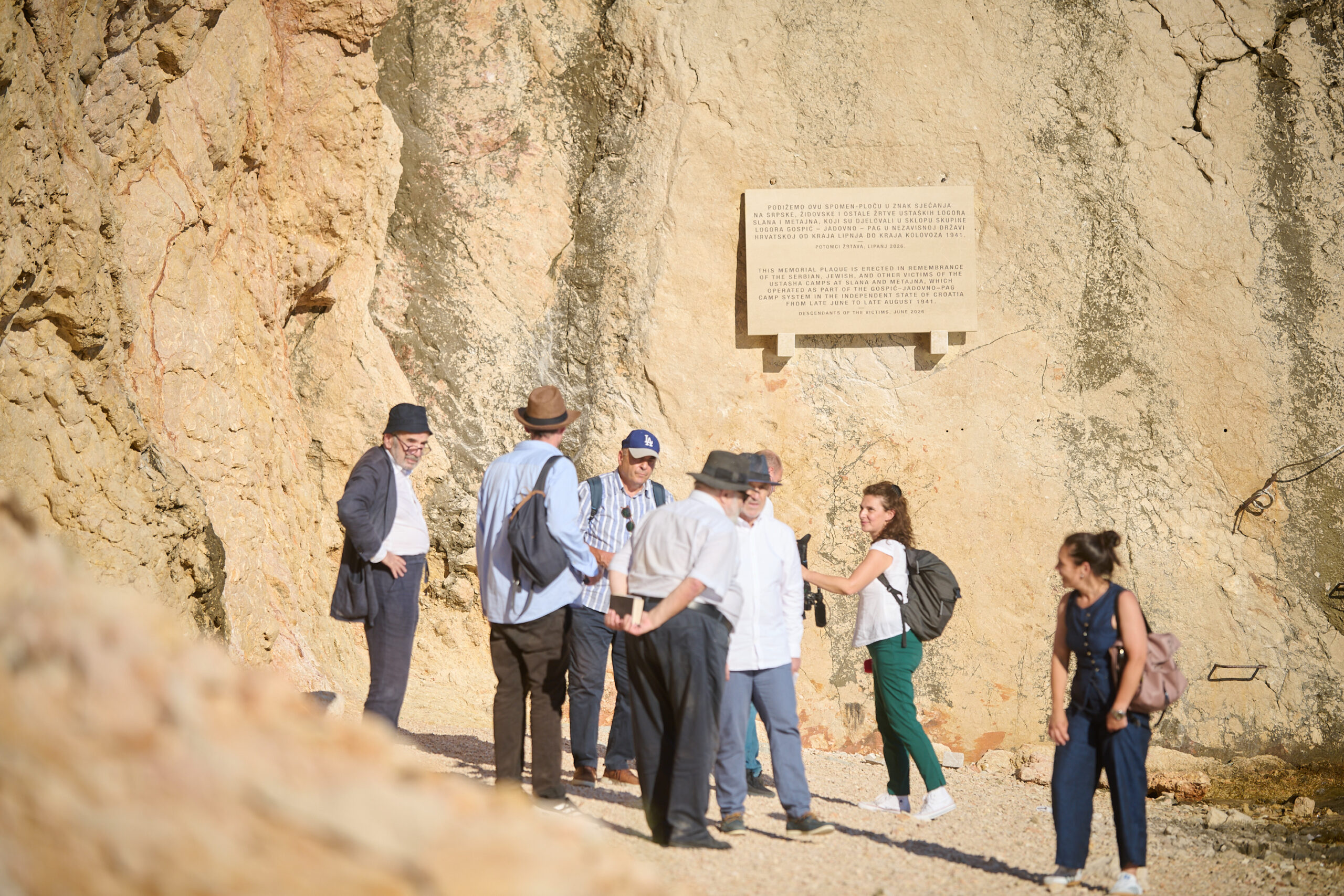
“May Slana continue to warn us today about the dehumanisation of the other, of those who are different, so that such atrocities may never happen again. And may all the victims rest in peace and may their relatives and family members accept my apologies,” said Mr Dabo, at the end of June this year, at the site of the former Ustasha camp in Slana Bay.
The aforementioned camp, whose existence is barely known to the public, was a death camp, the most brutal in the entire Independent State of Croatia (NDH) during the Second World War.
We call on the institutions of the Republic of Croatia, above all the Ministry of the Interior and the General Police Directorate, to conduct an effective investigation. We call on the Ministry of Culture and Media of the Republic of Croatia to issue a statement regarding the destruction of the plaque in an area of protected cultural heritage, and we call on representatives of the local and national authorities to condemn the vandalism and install a new plaque in the presence of representatives of the Government of the Republic of Croatia.
The Ustasha camp at Slana covered an area of around 5 hectares and was located approximately 5 km from the nearest village, Metajna, on the island of Pag. On that rocky wasteland, directly exposed to the Velebit bora, with no drinking water or vegetation, there were no conditions for normal life. The first internees of the camp on Pag were Jews arrested in Zagreb on 20 June 1941. They were brought to Slana on 24 June. That date can be regarded as the day the camp began operating.
The first group of prisoners consisted of 30 Jews from Zagreb. At the time of their arrival in Slana, there was nothing there except bare rock. After the Jews, Serbs and a smaller number of Croats were also brought there. From 10 July onwards, the number of Serbs was significantly higher. The northern part of the camp was occupied mainly by Serbs and, to a lesser extent, Croats, while the southern part was occupied exclusively by Jews.
Following the reoccupation by Fascist Italy, and on the basis of the Treaties of Rome with the Independent State of Croatia, the Velebit area and the island of Pag became part of Italy in mid-August 1941, resulting in the camp being closed down. The last camp inmates were killed or transported to other places of detention in the Independent State of Croatia at the time, while the Fascists themselves, including the sanitary and disinfection commission of the Italian army, were appalled by the brutality of the crimes committed.
Boris Milošević, Serb National Council (SNV)
Vesna Teršelič, Documenta – Centre for Dealing with the Past
Ognjen Kraus, Coordination of Jewish Municipalities of the Republic of Croatia